Most Dubai villa owners handle upkeep one of two ways. Either they wait for something to break and then call someone, or they sign an annual maintenance contract and let a single team look after the whole house on a schedule.
Both work. Neither is automatically cheaper. The honest answer to villa AMC vs on demand maintenance in Dubai depends on the age of your villa, how much equipment it has, how often you’re actually in the country, and how much of your own time you’re willing to spend chasing technicians in August.
This guide compares the two properly — where each one genuinely wins, where each one quietly costs more than it looks, and how to work out which side your villa falls on.
What is a villa AMC in Dubai?
An annual maintenance contract is a fixed-term agreement, usually twelve months, where a maintenance company takes responsibility for the routine upkeep of your villa. Instead of paying per job, you pay an annual fee and receive a defined package of scheduled visits plus, in most contracts, cover for call-outs when something goes wrong.
A typical villa AMC covers preventive servicing on the systems that fail most often in this climate — air conditioning, plumbing, electrical, and general handyman work — on a visit cycle agreed up front. Welldun’s own annual maintenance contracts start from AED 5,000 per year, with the exact scope set against the size and equipment of the villa.
The defining feature is not the price. It’s that the responsibility shifts. Somebody other than you is now tracking when the AC was last serviced.
What does pay-per-call maintenance actually mean?
Pay-per-call — also described as on-demand or reactive maintenance — is the default. Nothing is scheduled. When the AC stops cooling, the drain backs up, or a socket dies, you find a contractor, get a quote, approve it, and pay for that job.
There’s a real logic to it. You only spend money when there’s a problem, you’re never locked into a provider you’ve gone off, and for a newer villa with little going wrong, the annual spend can be genuinely low.
The costs that catch people out are the ones that don’t appear on any invoice: the hours spent finding someone available, the price you accept because it’s 45°C and you have no leverage, and the repairs that only became repairs because nothing was being checked.
Villa AMC vs pay-per-call: the honest comparison
| Annual maintenance contract | Pay-per-call repairs | |
|---|---|---|
| Cost pattern | One predictable annual figure | Unpredictable; nothing for months, then a large bill |
| Response time | Contracted; usually prioritised | Depends entirely on who’s free |
| Preventive work | Built in and scheduled | None unless you arrange it |
| Accountability | One team knows the whole villa | Split across whoever you last called |
| Peak-season risk | Covered by the agreement | Highest demand, highest prices, longest waits |
| Best suited to | Older or larger villas, absent owners, multiple systems | Newer villas, hands-on owners, low equipment load |
The table makes the trade look symmetrical. In practice it isn’t, and the reason is seasonal.
Why Dubai’s climate changes the maths
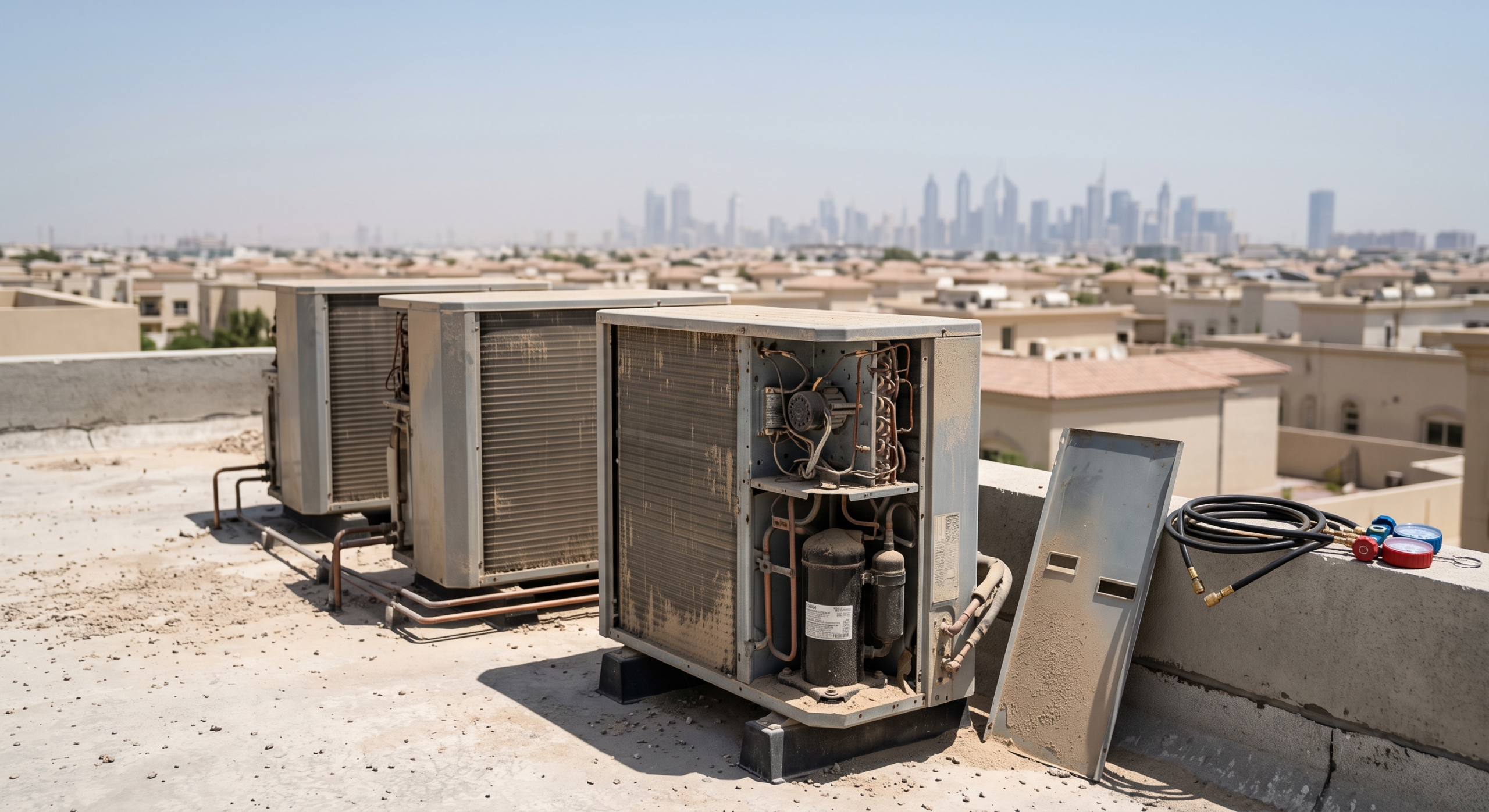
In a temperate climate, reactive maintenance is a defensible strategy — equipment degrades slowly and failures are spread through the year. Dubai doesn’t work like that.
Air conditioning here runs at high load for months at a stretch, which means it fails when it is under the most stress and when every other villa in your community is also under stress. That’s the moment you’re trying to book an engineer. Dust loads clog filters and condenser coils faster than most manufacturers’ service intervals assume. Water systems deal with hard water and long periods of high mains temperature. Outdoor equipment — irrigation, pool plant, external units — sits in direct sun.
The practical effect is that the cheap option and the expensive option are separated by whether a fault gets caught early. A filter change and a coil clean is routine work. The same unit left to run dirty until the compressor gives up is a different order of expense entirely, and it fails in August, not in January.
That’s the real comparison. Not AMC price versus repair price, but planned work versus emergency work.
When pay-per-call is genuinely the better choice
It would be dishonest to pretend a contract suits everyone. Reactive maintenance makes sense when:
- Your villa is new and still under developer or contractor warranty. Paying separately for cover you already have is waste.
- You live in the villa full-time and are attentive. If you notice the AC losing performance in week one rather than month four, you capture most of the benefit of preventive maintenance yourself.
- The equipment load is light. A compact villa with a couple of split units, no pool, and a small garden simply doesn’t generate enough maintenance events to justify an annual fee.
- You have a trusted contractor with real availability. The main weakness of pay-per-call is response time. If you’ve genuinely solved that, the weakness mostly disappears.
- You’re planning to sell or move within the year. A twelve-month commitment doesn’t fit a six-month horizon.
When an AMC wins clearly
The contract case is strongest in a fairly specific set of circumstances:
- The villa is five years old or more. Systems have moved past their trouble-free period and small faults start compounding.
- You’re not always here. Overseas owners and landlords can’t inspect anything themselves. A scheduled visit is the only mechanism that catches a slow leak before it becomes a ceiling.
- The villa is tenanted. Tenants report problems late, and every unplanned repair becomes a phone negotiation. A contract gives everyone one number to call.
- There’s a pool, extensive landscaping, or multiple AC zones. More systems means more failure points and more separate contractors to coordinate. Consolidating that under one team is worth real money in avoided hassle.
- You value the budget being fixed. Some owners would rather pay a known number than face an unknown one at the worst possible moment. That’s a legitimate reason on its own.
If several of these describe your villa, the annual figure will usually be lower than a year of reactive spending — and the gap widens the older the property gets.
How to work out your own break-even

You don’t need a spreadsheet, but you do need honest numbers rather than a feeling.
- Add up last year’s actual maintenance spend. Bank statements, not memory. Include AC servicing, plumbing call-outs, electrical work, handyman jobs, garden and pool maintenance, and anything you paid to fix something that broke.
- Add the jobs you postponed. The tap that still drips, the AC unit that’s noticeably weaker, the paintwork you keep meaning to sort. These are next year’s costs, not last year’s savings.
- Count your systems. AC units, water heaters, pumps, pool plant, irrigation zones. More systems means a higher realistic annual baseline.
- Price your own time. Hours spent finding contractors, getting quotes, waiting for someone to turn up, and re-doing work that wasn’t done properly.
- Get a scoped AMC quote for your actual villa — not a generic figure — and compare it against the total of steps one to four.
If the contract quote sits near or below that total, the decision is straightforward, because you’re also buying scheduled prevention and a defined response time on top of the same money. If it’s meaningfully above, reactive maintenance is probably still right for your villa this year — and worth reviewing again as the property ages.
What to check before signing any AMC

If you land on a contract, the value is in the detail, and contracts vary far more than their headline prices suggest. Before you commit, get clear answers on:
- Exactly which systems are included — and, more importantly, which are excluded. AC, plumbing, electrical, handyman, landscaping and pool are often priced separately.
- How many scheduled visits are included per year, and what happens on each one.
- Whether call-outs are covered or billed on top, and whether there’s a cap.
- What the emergency response commitment is — a stated response window, not a vague promise of 24/7 availability.
- Whether parts and materials are included or charged separately. This is the single biggest source of surprise invoices.
- What guarantee covers the work. Welldun backs its work with a twelve-month workmanship guarantee; ask any provider for theirs in writing.
- Whether the same team attends each time, because continuity is most of the reason a contract outperforms ad-hoc calls.
If a provider can’t answer these clearly before you sign, that tells you what the service will be like afterwards.
Frequently asked questions
Is a villa AMC in Dubai worth it?
For villas older than about five years, tenanted properties, and homes belonging to owners who travel or live abroad, generally yes — the contract catches faults early and removes emergency-rate pricing. For new, small, owner-occupied villas with few systems, pay-per-call is often still cheaper.
How much does a villa AMC cost in Dubai?
It varies with villa size, number and type of AC units, visit frequency, and whether landscaping, pool or call-out cover is included. Welldun’s contracts start from AED 5,000 per year, with the final scope quoted against the specific property. Treat any fixed figure quoted without a site assessment with caution.
Does an AMC cover emergency repairs?
Some do, some bill them separately, and some cover labour but not parts. This is contract-specific and needs to be confirmed in writing before signing rather than assumed.
Can I keep pay-per-call for repairs and take a contract only for AC?
Yes. Single-system contracts are common, and AC is the most sensible one to start with in this climate because it carries the highest failure cost and the worst seasonal availability.
What happens to my AMC if I sell the villa?
That depends on the contract terms — some transfer to the new owner, some don’t. Check the transfer and cancellation clauses before signing if a sale is a possibility.
The short answer
Pay-per-call maintenance is cheaper for newer, simpler, owner-occupied villas where someone is present enough to notice problems early. An annual maintenance contract is cheaper for older or larger villas, tenanted properties, and owners who aren’t around — because in Dubai’s climate, the difference between a routine service and an emergency replacement is usually just whether anyone was checking.
Work out your real spend from last year, count your systems, and compare that against a properly scoped quote. If you’d like the comparison run against your actual villa rather than an average one, get in touch — or look at what’s covered under Welldun’s annual maintenance contracts and our villa repair services to see where your property fits.