Two villas in Dubai can be the same size, the same age, and the same layout, and still need completely different maintenance. One sits four kilometres from the coast in Jumeirah, where salt in the air eats through outdoor AC condenser fins and metal fixtures. The other sits inland in Arabian Ranches, where the bigger problem is fine construction-adjacent dust clogging filters and irrigation emitters.
Same villa. Different failure modes. Different service schedule.
Most guides to villa maintenance services in Dubai treat the city as one place. It isn’t. What your villa actually needs depends heavily on where it sits — how close to the sea, how old the development, whether it’s a freehold community with its own service rules, and what the developer originally installed. This guide walks through what changes by area, and how to translate that into a maintenance plan that fits your property rather than a generic one.
What do villa maintenance services in Dubai normally cover?
Before the local differences, the baseline. A proper villa maintenance service in Dubai covers four broad areas:
- MEP systems — air conditioning, plumbing, and electrical. This is the bulk of the work and the source of most emergencies.
- Building fabric — doors, windows, joinery, tiling, paint, waterproofing, and roof or terrace surfaces.
- Outdoor systems — irrigation, landscaping, pool plant, external lighting, and drainage.
- Reactive repairs — the unplanned things, which is where response time matters more than price.
Some owners buy these piecemeal, calling a different contractor each time something breaks. Others bundle them into an annual maintenance contract with a defined visit schedule. Which makes more sense depends partly on the villa — and partly on the community it sits in.
Coastal villas: salt is the maintenance driver
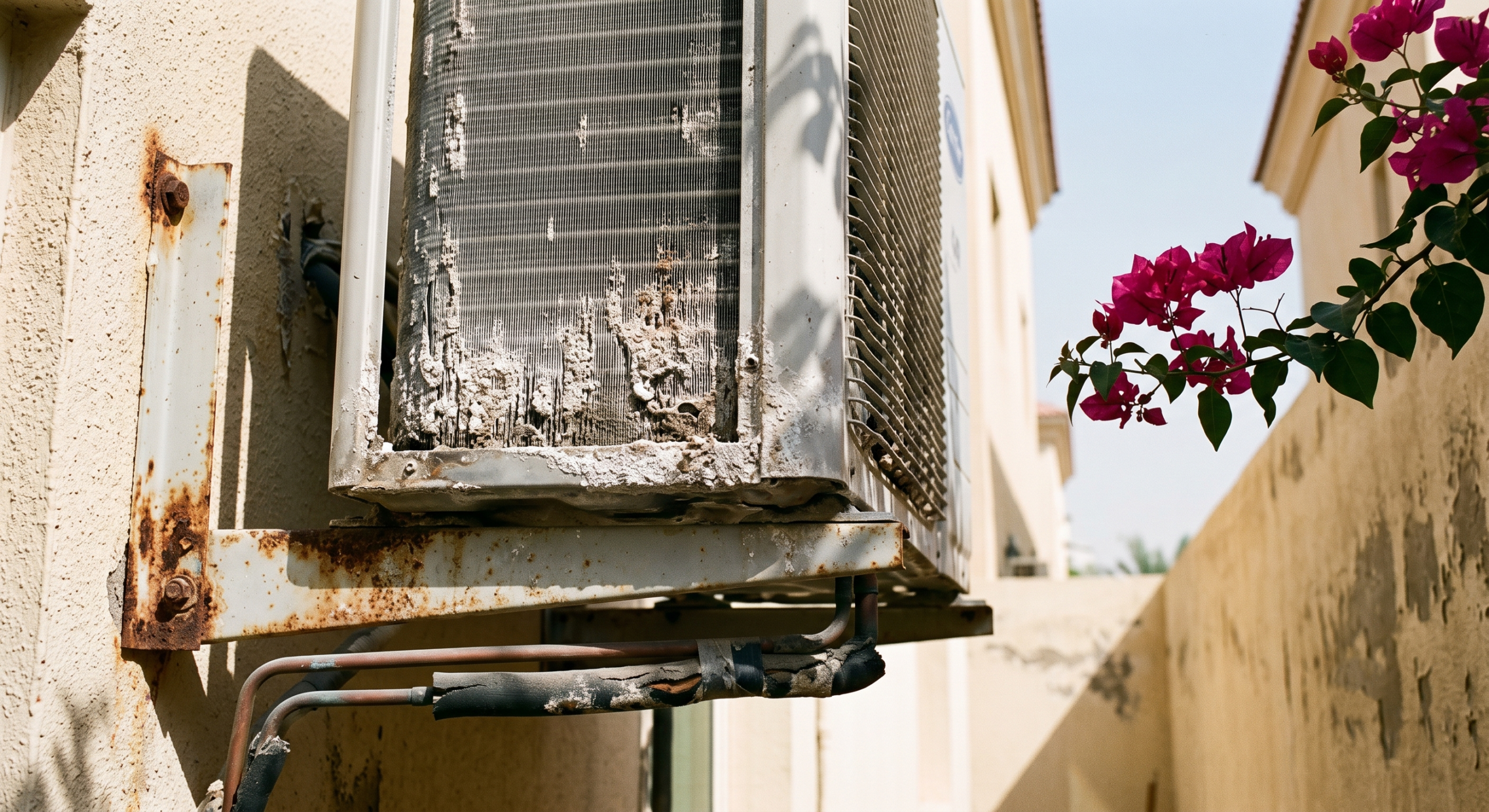
If your villa is in Jumeirah, Umm Suqeim, Palm Jumeirah, or anywhere within a few kilometres of the water, salt-laden humid air is the single biggest factor in your maintenance costs.
Salt accelerates corrosion on anything metal and exposed. In practice that means:
- Outdoor AC condenser units corrode faster. Fins degrade, coils lose efficiency, and the unit works harder for the same cooling — which shows up on the DEWA bill before it shows up as a breakdown.
- External hardware — gate hinges, balcony railings, outdoor light fittings, pool ladder fixings — pits and stains years earlier than the same fittings inland.
- Window and door tracks collect a fine salt residue that stiffens the mechanism and eventually damages seals.
The practical adjustment is frequency, not different work. Coastal villas benefit from condenser coil cleaning more often than the standard schedule, and from a rinse-and-inspect pass on exposed metalwork as a routine item rather than a reactive one. Owners who skip this usually discover it as a compressor replacement rather than a cleaning.
Inland and desert-edge communities: dust and irrigation
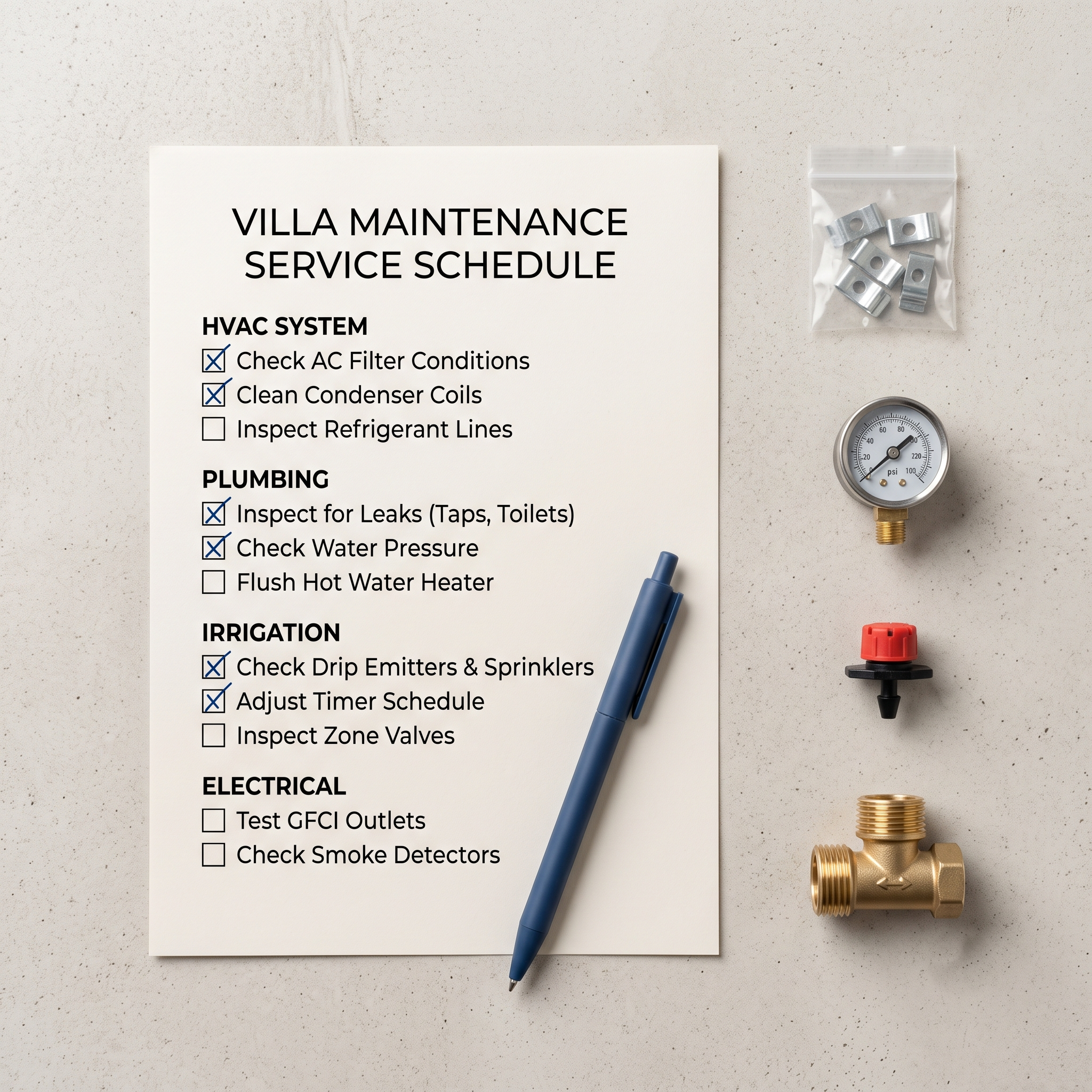
Arabian Ranches, Dubai Hills, Damac Hills, The Villa, Al Barari, and the newer developments toward Dubailand sit further from the sea and closer to open desert and, in many cases, active construction. The dominant problem shifts.
Dust does two things. It loads AC filters far faster than the manufacturer’s assumed schedule, and it settles in irrigation drip emitters and sprinkler heads until coverage becomes patchy. A garden that looks like it has a watering problem often has a blockage problem.
Landscaping load is higher. Larger plots with lawn, planting, and irrigation mean the outdoor portion of maintenance is a real line item rather than an afterthought. Systems that run on timers fail quietly — nobody notices a dead zone until the planting in it is beyond saving. Regular landscaping and outdoor care checks catch this while it’s still a cleaning job.
Newer builds have snag-adjacent faults. Villas handed over in the last few years often show first-year issues in waterproofing, joinery, and MEP terminations. If your villa is under five years old, the maintenance question is partly a defect-identification question.
Older established areas: the systems are the age of the villa
Mirdif, Al Barsha, parts of Jumeirah, and older Springs and Meadows properties share a different profile. The building fabric is usually fine. The systems behind it are twenty-plus years old.
What tends to matter here:
- Ageing pipework, where slow leaks develop inside walls and under slabs and only announce themselves as a ceiling stain or an unexplained water bill.
- Electrical loads the original design never anticipated — the distribution board was sized for a household that didn’t have three split units, an EV charger, and a home office.
- Waterproofing at bathrooms and terraces reaching end of life, which is one of the most expensive things to fix late and one of the cheapest to catch early.
For these properties the honest answer is often that maintenance and renovation overlap. Repeatedly repairing a bathroom that leaks because the membrane underneath has failed is more expensive over three years than doing it once properly.
Townhouses and cluster communities: the boundary question
In Springs, Meadows, Town Square, Mudon, and similar cluster developments, an extra factor enters: the split between what the community’s service charge covers and what you’re responsible for.
Typically the community handles external common areas, shared landscaping, and sometimes the building envelope. You handle everything inside the villa plus your own plot. But the line varies by development and by whether you own or rent, and it is worth reading rather than assuming — owners routinely pay twice for something already covered, or leave something uncovered because they assumed it wasn’t theirs.
Before signing any maintenance contract in a cluster community, get clear on three things: what the service charge already includes, what your tenancy contract assigns to landlord versus tenant if the villa is let, and whether the community has approved-contractor rules or access restrictions your provider needs to work around.
How often should each system actually be serviced?
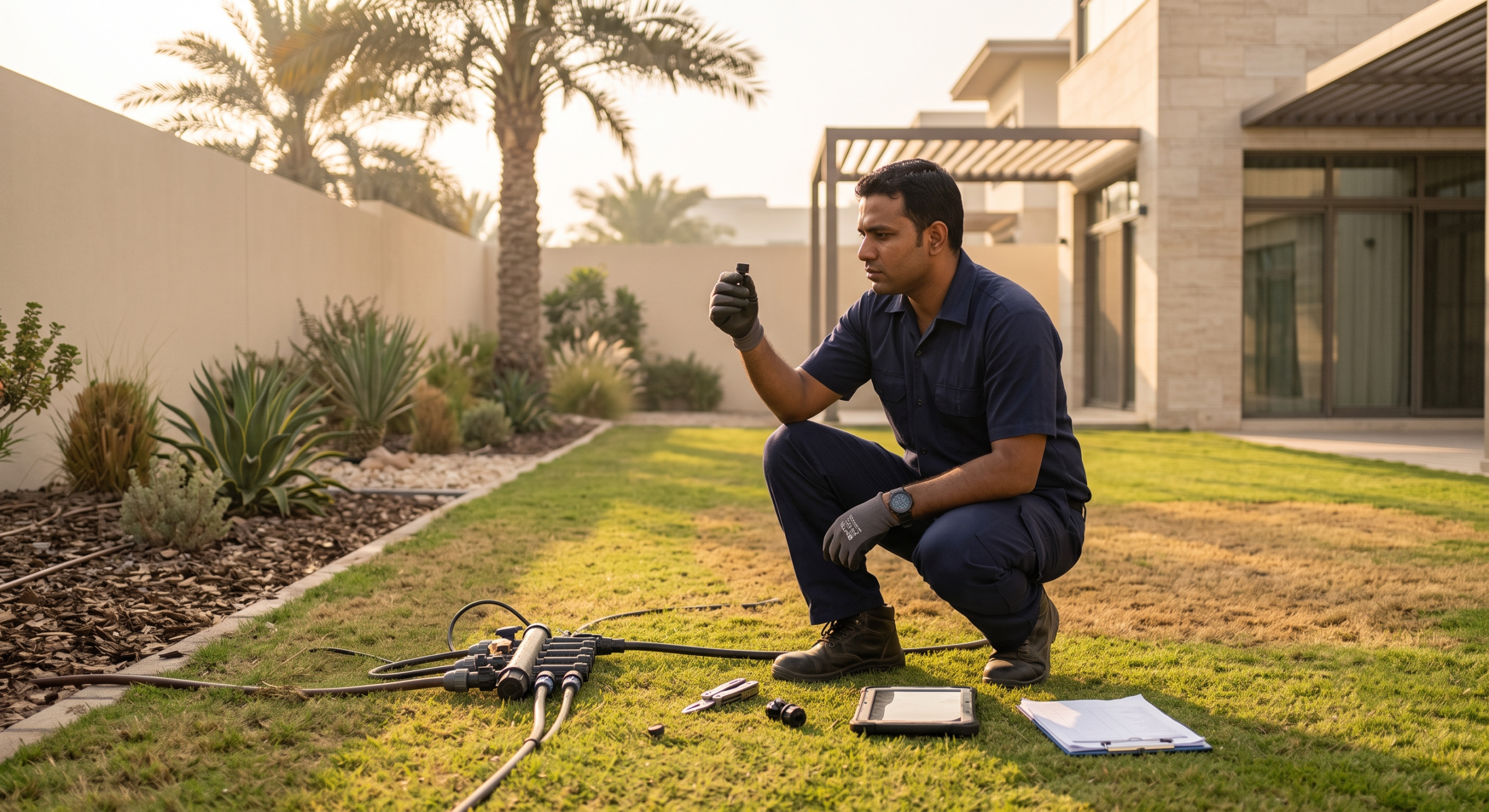
A workable baseline for a Dubai villa, adjusted up or down by the factors above:
| System | Baseline | Adjust up if |
|---|---|---|
| AC servicing | 2× per year | Coastal, dusty area, units over 8 years old, heavy occupancy |
| AC filter cleaning | Every 1–3 months | Near construction, pets, desert-edge location |
| Plumbing inspection | Annually | Villa over 15 years old, previous leak history |
| Electrical inspection | Annually | Older DB, added loads, any tripping history |
| Irrigation check | Seasonally | Large planted plot, drip system, summer months |
| Pool plant service | Weekly to fortnightly | Heavy use, larger volume |
| Waterproofing check | Every 2–3 years | Any staining, older bathrooms, flat roof or terrace |
The single most important entry is AC. In Dubai, cooling is not a comfort system, it’s a critical system, and it fails hardest in the month you can least tolerate it failing. Everything else can usually wait a week. That one can’t — which is why the villa repairs side of any maintenance arrangement should have a defined emergency response, not a best-effort promise.
Does the community change what you should ask a contractor?
It changes the emphasis. The questions worth asking are the same everywhere, but which answers matter most shifts:
- Coastal villa: how often do you clean condenser coils, and is exposed-metal inspection included or chargeable?
- New inland community: do you identify developer defects, and will you document them in a form I can use with the developer?
- Older property: do you carry out leak detection, and can you assess waterproofing condition rather than just repairing the symptom?
- Cluster community: have you worked in this development, and do you know its access and approved-contractor rules?
- Everywhere: who employs the technician, what’s the written scope, and what’s guaranteed for how long?
That last one does most of the work. A contractor who employs their own trades and puts a 12-month workmanship guarantee in writing is accountable in a way a coordinator of subcontractors structurally cannot be.
Frequently asked questions
Is a villa maintenance contract worth it, or should I just call someone when things break?
It depends on how much reactive work your villa generates. A newer villa with a small plot and two AC units may genuinely be fine on a pay-per-call basis. An older or larger property with a pool, irrigation, and five or more AC units usually costs more that way, because emergency call-outs are priced higher than scheduled visits and because unscheduled work means problems get found late.
Do coastal villas really need more maintenance?
More frequent maintenance of specific items, yes — mainly outdoor AC units and exposed metalwork. The rest of the schedule is broadly the same. The difference is real but narrow, which is why a good provider adjusts frequency rather than selling a different package.
Who pays for villa maintenance in Dubai, the landlord or the tenant?
It’s set by the tenancy contract, not by law in a fixed way. The common arrangement is that landlords cover major and structural items while tenants cover minor repairs and consumables, often up to a stated value per incident. Check the specific wording — the threshold varies.
How quickly should a maintenance company respond to an AC failure in summer?
Same day is the standard worth holding a contractor to between May and September. Ask what their actual emergency response commitment is and whether it’s written into the contract, because in July the difference between “24/7” and “next available slot” is the whole value of the arrangement.
Getting the plan to match the property
The useful version of villa maintenance services in Dubai isn’t a package you pick off a list. It’s a schedule that reflects where your villa sits, how old its systems are, and what it actually contains — a pool, a planted garden, six AC units, a twenty-year-old distribution board.
The starting point is an honest assessment of the property rather than a quote issued before anyone has seen it. If a contractor can tell you why your villa’s schedule differs from your neighbour’s, they’ve done the assessment. If the number arrives first, they haven’t.
If you’d like a scope built around your villa specifically, get in touch and we’ll walk the property before quoting.